
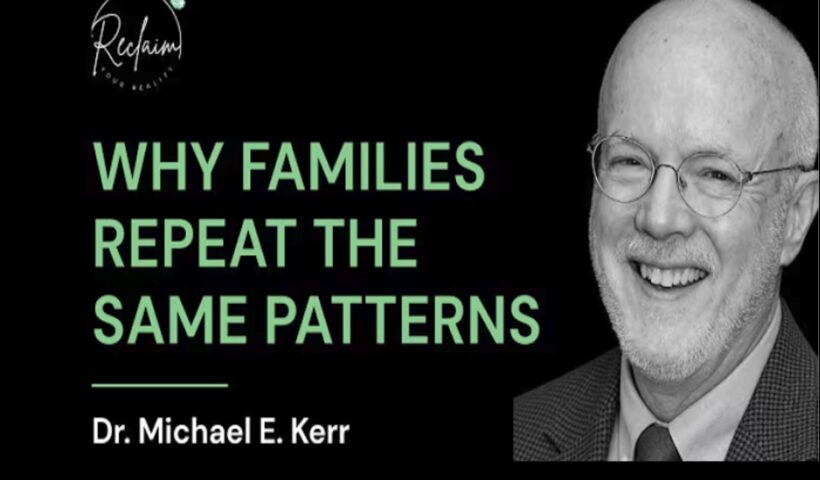
Michael Kerr, a long-time student and successor of Murray Bowen, is interviewed on Bowen theory, drawing on his personal and clinical experience to explore family relationships and social systems. The central argument presented in the interview is that Kerr’s perspective on Bowen theory, shaped by his own family history and professional life, can help listeners understand their families, relationships, and the systems they live in.
The discussion begins by contrasting Bowen’s family systems approach with Freudian thinking, including the rejection of the (older) concepts related to mothers with schizophrenic children in favor of viewing the whole family as an emotional system. It then turns to the family projection process as illustrated by Kerr’s brother Billy, whose experience shows how anxiety can move the focus onto one member and reframes blame as information about the system rather than a verdict on a person.
Kerr next examines differentiation of self and the qualities of a family leader, followed by the value of staying neutral and studying one’s own part in the system, and concludes with the concept of societal regression and the anxious state of the wider world. Chronic anxiety is portrayed as an invisible force that everyone reacts to but few perceive, and the speaker holds that change begins with seeing things differently than before.
Webinar Overview
What is this transcript about?
Why Families Repeat the Same Patterns is a 2026 conversation in which Michael Kerr presents his perspective on Bowen Family Systems theory. Kerr traces his introduction to Murray Bowen’s ideas from a medical school lecture, describes working alongside Bowen for roughly twelve to fifteen years, and explains how he took on the responsibility of carrying Bowen’s work forward after Bowen’s death.
The conversation covers the core concepts of the theory — the family as an emotional system, the family projection process, self-differentiation, emotional cutoff, and societal regression — and grounds each concept in Kerr’s own marriage, his relationship with his brother Billy, and his clinical supervision under Bowen. The date of the conversation is 2026-09-13.
Kerr also extends the theory outward, connecting chronic family anxiety to chronic physical inflammation and connecting the same emotional processes that operate in families to the polarization and reactivity visible in public institutions and political life.
Why does this matter?
A reader who understands the material in this conversation gains a framework for interpreting family conflict that does not require identifying a villain. Michael Kerr’s central argument, following Bowen, is that problems that look like one person’s pathology are products of anxiety moving through a system of relationships. That reframe changes what a person looks for and what they try to do about it.
The practical stakes are concrete. Kerr describes how seeing the pattern “when I react, she reacts” transformed a moment in his marriage, and how Bowen’s letter criticizing his distance from his family redirected years of his personal development. Without this lens, most people default to blaming others or themselves, which Kerr says feeds the anxiety rather than reducing it.
At the societal level, Kerr argues that the same processes operating in a family — chronic anxiety, reactivity, polarization, and short-term thinking — are now visible in governments and media worldwide. Understanding the process does not automatically fix it, but Kerr says it can settle people and help them avoid being swept into the reactivity themselves.
What are the key topics discussed?
Bowen’s Family Systems approach versus Freudian thinking. Kerr recounts how Bowen rejected the idea of the “schizophrenogenic mother” and instead treated the whole family as an emotional system, and how that shift drew Kerr to Bowen despite warnings from colleagues. Kerr uses forest and bird imagery to illustrate that every living thing is connected in an emotional system.
Family projection process and Kerr’s brother Billy. Kerr describes how his mother’s intense protective focus on his brother Billy illustrates the family projection process. Billy was later diagnosed with schizophrenia, and Kerr visited his grave to thank him for absorbing the greater force of the family system.
Chronic versus acute anxiety and its physical effects. Kerr distinguishes acute anxiety, which responds to real threats, from chronic anxiety, which is more imagined and poorly understood. He describes chronic anxiety as an invisible force moving through the system and suggests it can generate chronic inflammation underlying physical illness.
Differentiation of self and the family leader. Kerr presents Bowen’s scale of no self, pseudo-self, and solid self, and reads Bowen’s quote on a family leader whose energy goes to changing self rather than directing others. Kerr’s sailboat story and the observation “when I react, she reacts” show differentiation of self playing out in everyday marriage.
Staying neutral and studying your own part in the system. Kerr recalls watching Bowen remain outside his emotional system during supervision and describes how difficult that neutrality is with one’s own family. He advises studying the system and one’s own part in it, and starting with a multigenerational view that avoids blaming parents or grandparents.
Emotional cutoff and healing within the family. Kerr discusses his mother’s reaction to his career choice and Bowen’s letter criticizing his distance from his family. He stresses that physical distance is not differentiation and that Bowen held that healing must happen within the system.
Societal regression and the anxious world. Kerr explains Bowen’s concept of societal regression, citing the nightly news, rising divorce rates, youth criminality, authoritarian leaders, and a polarized Congress as indicators. He doubts change will come until people are forced by the accumulated pain of the present.
Kerr’s closing advice to understand and observe. Kerr recommends reading Murray Bowen’s collected papers and says that understanding the systems we live in can settle people even when they cannot change them.
Key terms and definitions
Family as an Emotional System — Bowen’s view that a family is not a collection of separate individuals but a system in which what one person feels and does moves through relationships and changes the functioning of everyone around them.
Systems Thinking — An approach that explains family problems by looking at the whole family and the interactions among its members, rather than locating the cause in one individual.
Family Projection Process — The pattern in which one child becomes the focus of the family’s anxiety, worry, and emotional intensity, absorbing a disproportionate force of the family system.
Chronic Anxiety — Anxiety that is more imagined than real and flows through the family system from person to person; Kerr describes it as an invisible enemy that everyone reacts to without fully understanding it.
Self-Differentiation — The ability to remain grounded in one’s own position without being automatically pulled into the emotional reactivity of a family system, described by Bowen as a scale from no self to pseudo-self to solid self.
Pseudo-Self — The middle point on Bowen’s differentiation of self scale, where most people operate, reacting to anxiety and fitting into the system rather than functioning from a stable sense of self.
Emotional Cutoff — The pattern of seeking relief from family tension through distance; Kerr stresses that distance changes the setting but does not change how one functions in relation to the system.
Societal Regression — Bowen’s term for chronic anxiety spreading through an entire society until reactivity, polarization, and short-term thinking dominate institutions and public life.
Family Leader (Bowen Quote) — In the quote Kerr reads, the ideal figure for family treatment is a member who defines self, invests in the family’s welfare, directs energy toward changing self rather than others, and whose movement toward differentiation causes family symptoms to disappear.
Multigenerational Perspective — Kerr’s recommended entry point for exploring one’s family: recognizing that no single person creates the problem, because it is an interactive process across generations, and refraining from blaming parents or grandparents.
Key takeaways
- Michael Kerr argues that family problems are products of anxiety moving through a system, not the fault of one individual.
- Bowen’s family projection process means one child often absorbs a disproportionate share of the family system’s anxiety, as Kerr’s brother Billy did.
- Self-differentiation, on Bowen’s scale from no self to pseudo-self to solid self, is the mechanism through which lasting personal change occurs.
- Physical distance from a family is not the same as differentiation; Michael Kerr relays Bowen’s position that healing must happen within the system.
- Kerr extends Bowen’s framework to society, describing polarization and reactivity in public life as signs of societal regression driven by chronic anxiety.
- Kerr’s closing recommendation is to read Murray Bowen’s collected papers and to understand the system one lives in, even when one cannot change it.
Frequently asked questions
What is Bowen Family Systems theory?
Bowen Family Systems theory treats the family as an emotional system in which anxiety moves through relationships and affects every member, rather than residing in one individual. Murray Bowen developed the theory after observing patients together with their families at the National Institute of Mental Health. Michael Kerr has carried the theory forward for more than sixty years.
What is differentiation of self in Bowen theory?
Differentiation of self is the ability to remain grounded in one’s own position without being automatically pulled into a family system’s emotional reactivity. Bowen described it as a scale running from no self, to pseudo-self, to solid self. Michael Kerr says most people operate at the pseudo-self level, reacting to anxiety rather than responding from a stable sense of self.
What is the difference between emotional cutoff and differentiation?
Emotional cutoff is the pattern of seeking relief from family tension through physical or emotional distance. Differentiation means changing how one functions within the system, not changing the setting. Michael Kerr relays Bowen’s position that healing happens within the system, not by leaving it.
What is societal regression according to Bowen theory?
Societal regression is Bowen’s term for chronic anxiety spreading through an entire society until reactivity, polarization, and blame dominate public life. Michael Kerr cites the nightly news, polarized government, and popular authoritarianism as signs. Bowen believed society would change only when the pain of continuing outweighed the pain of taking a long-term view.
What is the family projection process?
The family projection process is the pattern in which one child becomes the focus of the family’s anxiety, worry, and emotional intensity rather than that anxiety being distributed evenly. Michael Kerr illustrates it with his brother Billy, whom their mother treated as a fragile figure needing constant protection, and who was later diagnosed with schizophrenia.
What did Michael Kerr recommend for someone new to Bowen theory?
Michael Kerr recommended reading Murray Bowen’s collected papers as the starting point. He also advised taking a multigenerational perspective on one’s family without blaming parents or grandparents, and studying one’s own part in the system rather than trying to change others.